Free live webinar · 30 minutes
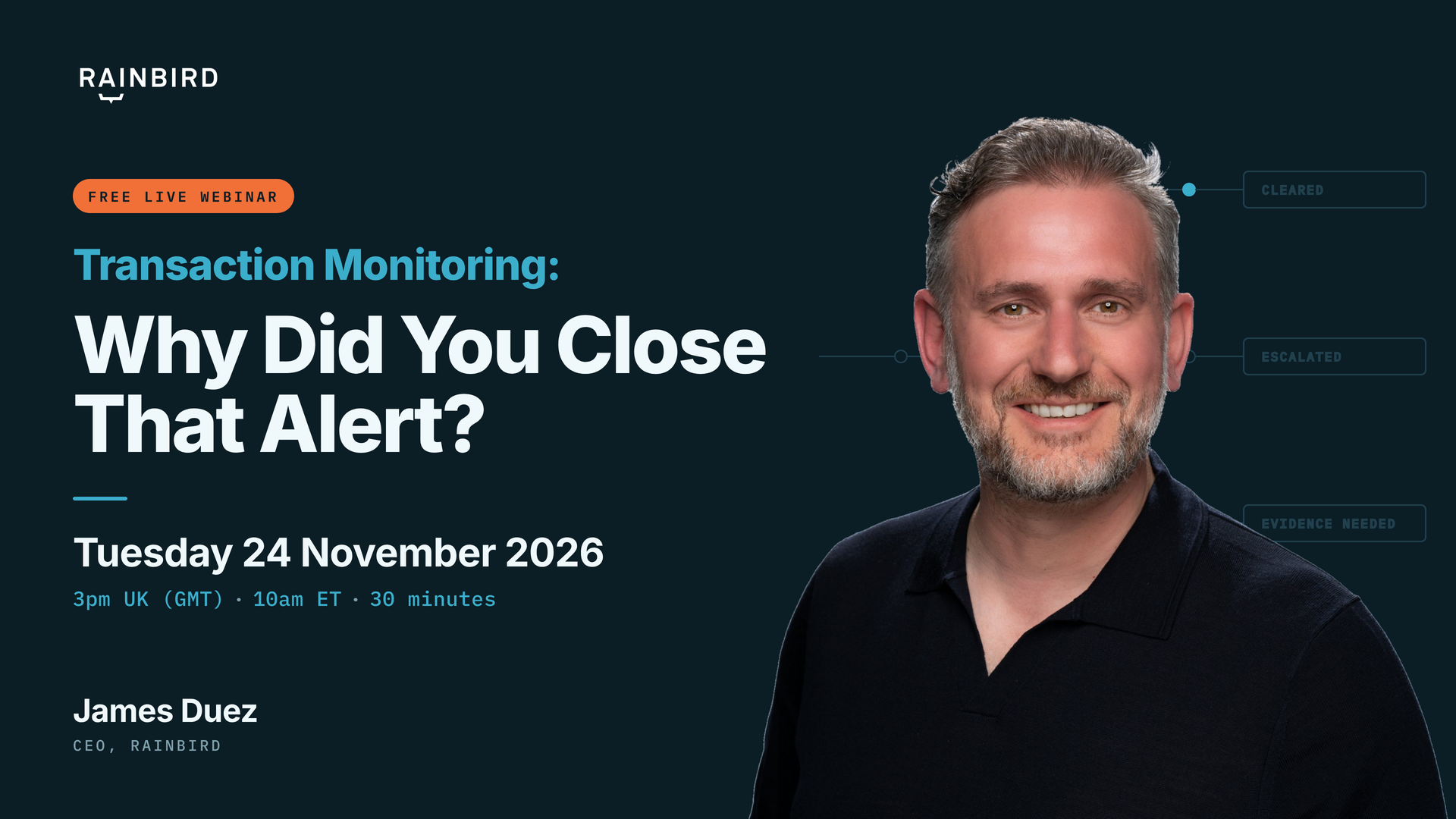
Transaction Monitoring: Why did you close that alert?
A free 30-minute session with James Duez, CEO of Rainbird, on why most of the $61 billion spent on financial crime compliance in North America goes on humans closing alerts as false positives, and how deterministic decisioning can transform this work.
Tuesday 24 November 2026 · 3pm UK (GMT) / 10am ET · 30 minutes
Free. Live on Zoom. The recording goes to everyone who registers.
What you’ll learn
- The role of language models and where they stop.
- How to create a trusted model of policy, typologies and risk.
- What deterministic and auditable disposition looks like.
- How to ensure a complete and compliant record for alerts.
The bottleneck has moved to the decision
Detection has been refined for twenty years, and now language models are being explored to augment the investigation. Yet the decision at the end of this process is still a human who has to clear, escalate or investigate, write the rationale, and defend it to QA, internal audit and the regulator.
Financial crime compliance costs US$61 billion a year in the US and Canada and labour is the largest line at 42%, most of it spent closing alerts. >90% are false positives, each needing a documented disposition that takes half an hour or more.
Regulators are now asking for the decision. The FCA’s October findings on AI call over-reliance on a human reviewer poor practice. FinCEN’s proposed programme judges controls on whether they work. The Wolfsberg Group’s 2025 statement on monitoring makes explainability a condition of whatever replaces legacy systems.
Two analysts processing the same alert should not be able to produce two different answers, whether human or AI.
- CUSTOMER
- Retail current account, 11 years
- TRIGGER
- Cash deposits under threshold, 6 in 9 days
- AMOUNT
- £41,300 aggregate
- RAISED
- Today, 09:14 · queue position 212
Illustrative alert, not customer data
What you will see in 30 minutes
- 1
Why a language model alone is not the answer
It cannot guarantee the same answer twice or show the rule it applied. The FCA now calls a person checking its output poor practice on its own.
- 2
Adjudication as policy application, not prediction
Your existing procedure, typologies and risk appetite encoded as an auditable model that your own staff author and test, so every disposition comes with the rules and facts behind it.
- 3
A live demo
One cleared, one escalated, and one where the Rainbird Reasoning Engine names the evidence it needs before it will decide. Then we open the evidence tree and change a threshold live.
- 4
What changes
QA tests the model instead of sampling dispositions. Policy changes become testable releases. Every decision carries its own record. Analysts work the ambiguous cases.
Your speaker

James Duez
CEO and co-founder, Rainbird
James co-founded Rainbird in 2013 and has spent over 30 years working in financial risk and compliance helping banks, insurers and professional services firms make decisions that are consistent, evidenced and defensible. He will present the session and take questions.
Who should attend
Financial crime and AML operations leads
You run the queue and answer for the consistency of its decisions.
Compliance, model risk and internal audit
You review the rationale and need it to map to policy.
Data, AI and transformation leads
You are deciding where language models belong in the AML workflow and where they do not.
Ninety-five per cent of alerts are cleared as a false positive, but each one still needs a rationale.
Transaction Monitoring: Why did you close that alert?
Tuesday 24 November 2026 · 3pm UK (GMT) / 10am ET · 30 minutes
Can't make it live? Register anyway and we'll send you the recording.
Register free
Save your place. We'll send the joining link and, afterwards, the recording.