FCA Targeted Support (PS25/22)
Live
Operate the targeted support decision chain, from segment qualification and the better-position test to suggestion selection, with Consumer Duty evidence for every interaction. Run it live here →
Knowledge graph · FCA Targeted Support (PS25/22)
Verity Oyelaran, 43, holds a £96,000 single stock beside a £144,000 diversified global fund and asked for help with diversification. The firm's own records say she intends to withdraw her whole portfolio within twelve months.
One MCP call injects the complete case payload: 10 case facts, 35 about Verity, 18 data-record facts
Every interaction ends in one of 21 named outcomes, with the rationale a firm files for FCA supervision.
A reference model for the FCA's targeted support regime, live since 6 April 2026. Given one firm and consumer interaction, it decides whether a ready-made suggestion may be delivered, which suggestion on what segment basis, and what must be disclosed, charged or signposted instead, working through the full COBS 9B chain from perimeter to disclosure. Where the data cannot support a determination, it requests further data rather than deciding without it.
Grounded in RAO article 55A, COBS 9B under PS25/22, the joint FCA, ICO and FOS statements and the Consumer Duty, it spans pension and retail investment situations: 286 rules traced to 138 requirements in both directions, every threshold held as recalibratable firm policy data, verified with 23 passing Studio tests.
This knowledge graph and its accompanying documentation have been constructed from publicly available legislation, regulatory guidance and published research. It is made available for demonstration and evaluation purposes and you are free to download it and adapt it to your own policy.
30 August 2026
11 scenario and policy-boundary evals and 12 adversarial and boundary evals, all 23 passing with engine-exact certainties, including a two-sided fringe pair either side of the excess-cash policy floor.
See this accelerator in action.
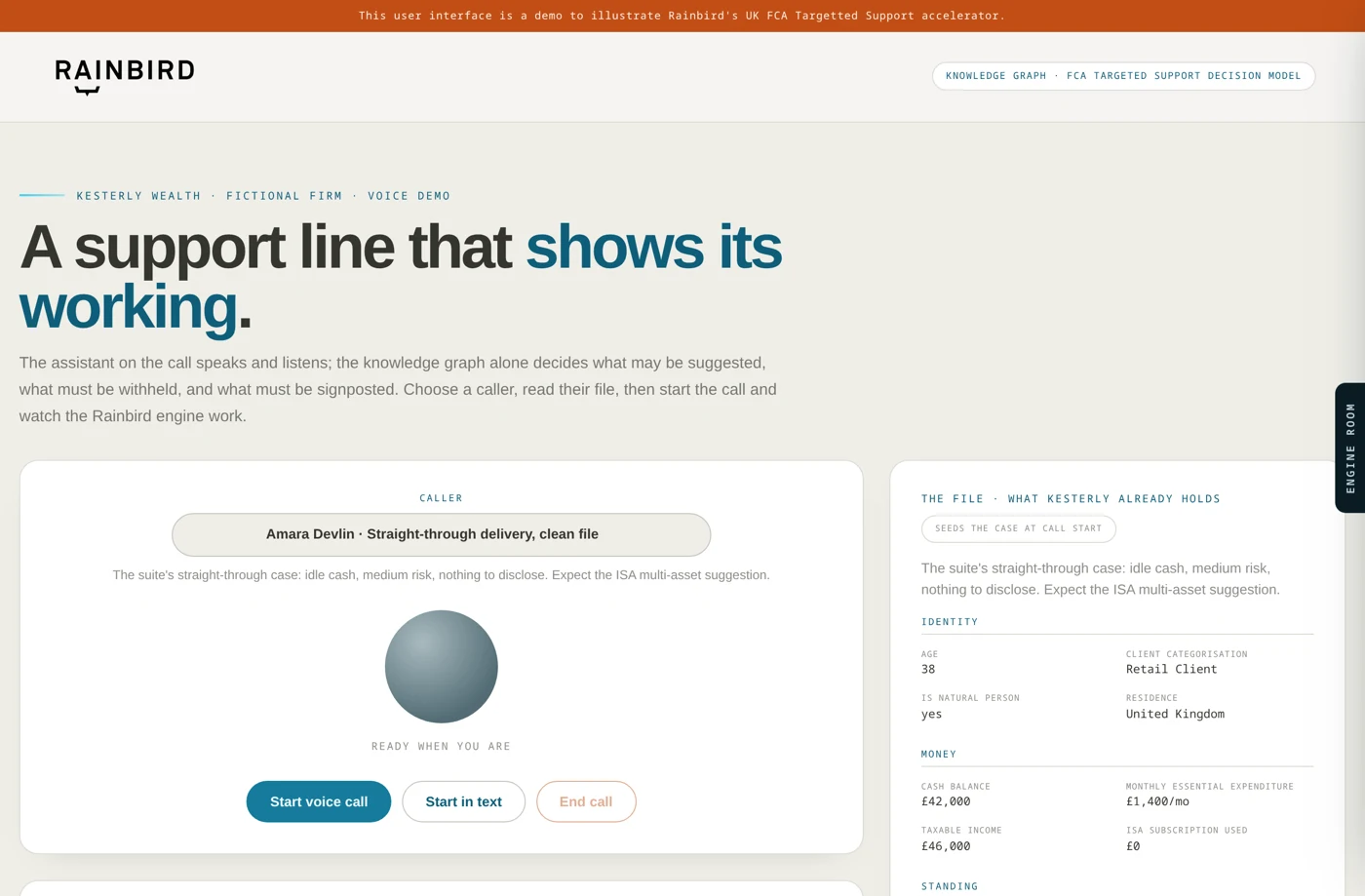
We've built a demonstration application with twenty-two synthetic support cases across pensions and retail investments, from a thirty-eight-year-old with £42,000 sitting idle in cash to a consumer whose own records show she plans to cash out within the year.
Each case is put to the live Rainbird agent and comes back with its outcome, its certainty, the suggestion and the segment it rests on, the signposts and next steps where support cannot help, and the supervisory-file entries a firm would retain for the FCA.
Open the evidence tree on any result and walk every step the engine took, down to the data record and staleness window each one rests on.
The firms, consumers and figures are all fictitious and for evaluation only.
Download the accelerator and try it yourself.
Download the graph, load it into your free Rainbird account, query it from an agent, then pivot it to your policy.
One file, with everything below inside it.
Import it into RAKE to open the graph, tests and documentation as a project.
- Rainbird graphRBLang XML · 286 rules
- Studio test suite23 tests, engine-exact
- Solution documentationMarkdown
- Regulatory cross-referenceMarkdown
- MCP connection guideGenerated on import
- MIT licenceMarkdown
fca-targeted-support.rake
Version 1 · verified 30 August 2026
This accelerator is open source under the MIT licence. The knowledge graph, test suite and documentation are free to download, inspect, adapt, redistribute and use, commercially included, provided the licence notice travels with them. They encode public regulation, guidance and research and are offered for demonstration and evaluation, not as legal or regulatory advice: every numeric threshold here is firm policy data, so calibrate the policy surface to your own risk appetite before relying on it. The graph runs on Rainbird. Community Edition and the hosted test endpoint are free for evaluation and non-commercial use with no service level; production use on Rainbird requires a commercial licence.
Run this decision against your own cases
Contact us to discuss your decision use case.