GENIUS Act Stablecoin Compliance
Live
Adjudicate stablecoin transactions under the GENIUS Act, the BSA and OFAC’s sanctions rules, deciding whether to process, block, reject, freeze, hold or file, and derive every institution’s duties, with a regulator-ready rationale that names the authority each decision rests on. Run it live here →
Raelog model · GENIUS Act Stablecoin Compliance
Granite Harbor Bank NA, assessed on 1 March 2027 after the Act takes effect, receives a $4,500 customer redemption in Harbormark Dollar from Wallet SDN 1 and already holds the asset. The wallet is an SDN-listed digital currency address.
One MCP call injects the complete case payload: 52 facts across the transaction, its wallet, both parties and the policy date
Every stablecoin transaction ends in one of seven dispositions, with a rationale that names the law, the proposal or the house policy it rests on.
This is a reference model for stablecoin compliance under the GENIUS Act and the BSA and OFAC framework around it. Given one transaction, its counterparty wallet’s analytics record and the institution evaluating it, the agent returns exactly one of seven dispositions: Process, File Suspicious Activity Report, Hold Escalate To Sanctions Officer, Escalate Incomplete Record, Reject, Block or Freeze Pending Lawful Order. Each carries a certainty, a rationale labelled FINAL LAW, PROPOSED, GUIDANCE or HOUSE POLICY, the reporting obligations it accrues with their deadlines, the recommended next step and a one-query case file. Given an institution, it derives which GENIUS Act duties attach to its role and whether its AML and sanctions programme is adequate, deficient or not fully evidenced. An incomplete record escalates; unknown never processes.
The law is encoded as it stood on 14 September 2026: the GENIUS Act is final law, the April and June 2026 FinCEN and OFAC proposals are labelled as proposed, and the statutory effective date of 18 January 2027 drives a three-era model from an injected evaluation date.
This model and its accompanying documentation have been constructed from publicly available legislation, regulatory guidance and published research. It is made available for demonstration and evaluation purposes and you are free to download it and adapt it to your own policy.
14 September 2026
35 transaction scenarios, 6 institution obligation personas, 20 adversarial probes and 7 statutory boundary tests, all 68 passing with engine-exact certainties and no interview questions, including the era boundaries verified to the statutory day.
See this accelerator in action.
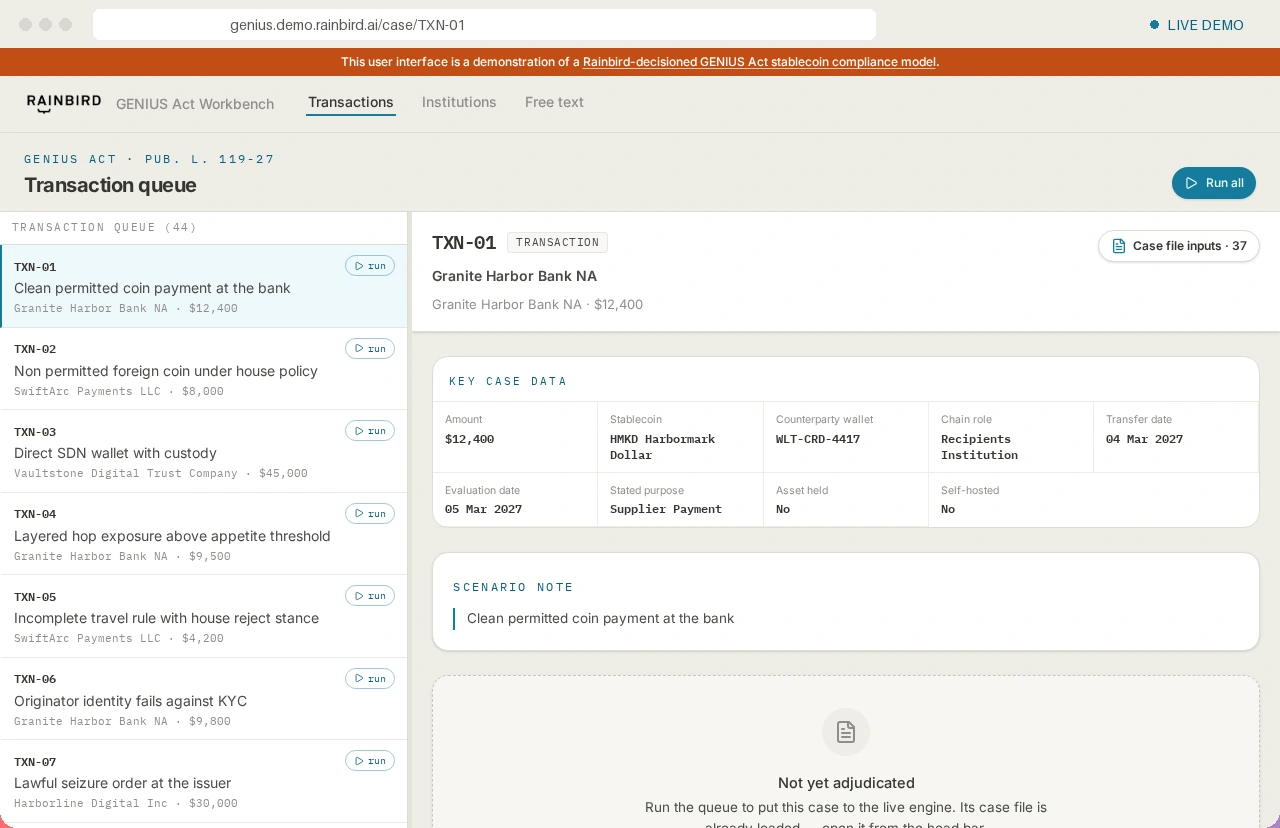
We’ve built a demonstration application with thirty-five synthetic stablecoin transactions and five institutions, from a clean supplier payment in a permitted coin to a receipt from a sanctioned wallet the bank already holds.
Run one, or run the queue, and each transaction is put to the live Raelog agent and comes back with its disposition, its certainty, a rationale that names the law or the house policy it rests on, the reporting obligations and deadlines it accrues, and the next step.
Switch to an institution and see which GENIUS Act duties attach to its role and whether its programme is adequate, deficient or not fully evidenced.
Open the evidence tree on any result and walk every step the engine took, down to the feed record each one rests on.
The institutions, coins, wallets and jurisdictions are fictitious and for evaluation only; the law is real.
Download the accelerator and try it yourself.
Download the model, load it into your free Rae account, query it from an agent, then pivot it to your policy.
One file, with everything below inside it.
Import it into Rae to open the model, tests and documentation as a project.
- Raelog modelRaelog XML · 427 rules
- Rae test suite68 tests, engine-exact
- Solution documentationMarkdown
- Regulatory cross-referenceMarkdown
- MCP connection guideGenerated on import
- MIT licenceMarkdown
genius-act-stablecoin-compliance.rake
Version 1 · verified 14 September 2026
This accelerator is open source under the MIT licence. The model, test suite and documentation are free to download, inspect, adapt, redistribute and use, commercially included, provided the licence notice travels with them. They encode public regulation, guidance and research and are offered for demonstration and evaluation, not as legal or regulatory advice: calibrate the house-policy thresholds to your own risk appetite before relying on them.
Run this decision against your own cases
Contact us to discuss your decision use case.