
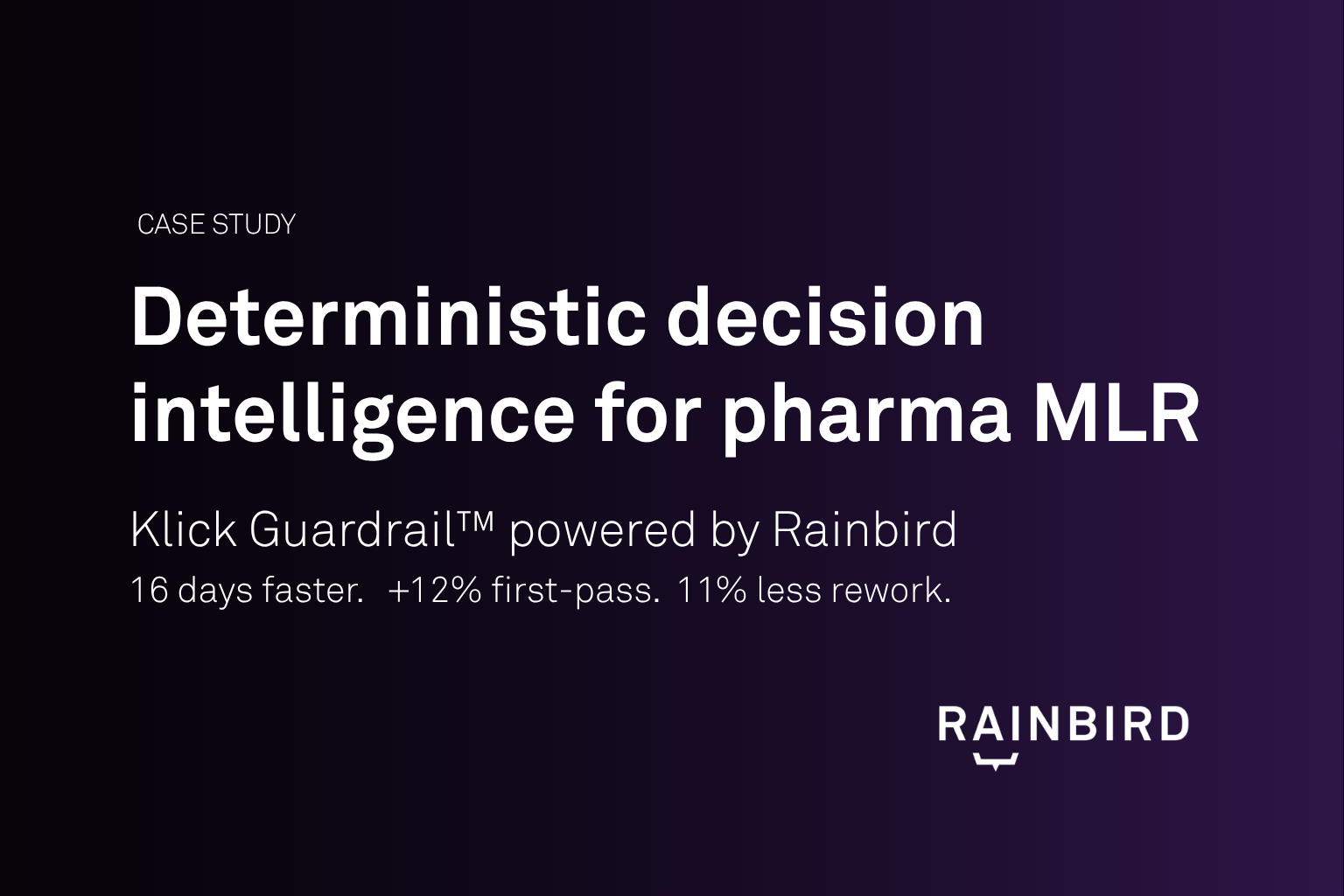
Klick Guardrail™, powered by Rainbird
Accelerating pharma MLR without compromising compliance
Summary
Klick Guardrail™ helps pharmaceutical teams move through Medical, Legal and Regulatory (MLR) review faster, while making every claim more consistent, traceable and defensible. The capability that makes this possible is Rainbird.
Guardrail leverages Rainbird’s deterministic decision tool as a sub-agent in the solution. Regulatory rules, interpretations and a company’s own risk appetite are encoded explicitly, so the same claim is always evaluated the same way, with a clear reasoning trail behind every decision. That is what separates Guardrail from probabilistic AI tools that give different answers to the same question.
Klick has used the platform internally across around 50 drug brands. In one client engagement, Guardrail cut average MLR cycle time by 16 days, lifted first-round approvals by 12%, and reduced rework costs by 11%, without loosening compliance.
Visit Klick Guardrail: https://guardrail.klick.com
Klick Health is the world’s largest independent commercialization partner for life sciences, focused on hacking the boundaries of health by developing, launching, and supporting life sciences brands to achieve their full potential.
The challenge: MLR at scale
In pharmaceutical marketing, speed and precision are both mandatory. Neither gives way to the other.
Every asset, a website, a visual aid, a brochure, a sales tool, has to pass MLR review before it reaches the market. Claims must be accurate, evidenced, and worded in line with approved language. Any deviation, however small, can trigger delays, rework or rejection.
It’s getting harder. Digital channels multiply. Personalised content expands the volume of material. Search behaviour is shifting towards AI chat interfaces. Each of these helps patients and healthcare professionals, and each makes MLR slower and more complicated. Meanwhile budgets hold MLR teams at the same size while submissions climb.
The problem compounds at scale. A single launch can involve hundreds of assets, several agencies, distributed internal teams and shifting regulatory interpretation. Reviewers change. Context gets lost. Claims approved last quarter get challenged again.
The cost of delay is steep. For a blockbuster drug expected to clear $1bn a year, a missed launch window can mean millions in lost revenue each day. Getting it wrong costs more: reputational damage, regulatory action, even withdrawal from the market.
Traditional MLR was never built for this volume, speed or complexity.
What pharma actually needs
The Pharma companies aren’t trying to get around regulation. They’re trying to work through it more efficiently.
Most of the friction is avoidable:
- Non-compliant language caught while content is being written, not after
- Approved claims reused with confidence
- Regulatory interpretation that’s consistent, not dependent on which reviewer picks it up
- Fewer rounds of back-and-forth between creators and reviewers
The hard part is doing all of this without adding risk. That is exactly where most AI tools fall down in regulated settings.
The Rainbird engine inside Klick Guardrail
Guardrail’s differentiator is what happens before a claim ever reaches formal review.
Klick describes this as Guardrail’s decision intelligence, applying fixed decision rules to every claim. That decision tool is Rainbird. Rainbird assesses whether a claim is likely to be approved, based on regulatory rules, historical approvals and the organisation’s own risk tolerance. Those rules and interpretations are encoded explicitly, not inferred. The same inputs always produce the same outcome, with a reasoning trail that shows why.
That design gives three things regulated teams need:
Consistency. A claim is evaluated the same way every time, whoever submits it.
Auditability. Every decision carries an evidence trail that can be reviewed, challenged or refined.
Trust. Teams can act on the output without second-guessing it.
Probabilistic models can’t offer this. Ask them the same question twice and you may get two answers, with no account of how either was reached. In an environment where regulators expect you to show your reasoning, that’s a non-starter.
How it works in practice
Three connected capabilities utilize the Rainbird decision tool:
In-context guidance. Guardrail works inside the tools content creators already use, document editors and design platforms. As copy is written, it flags language that may fall outside approved claims and suggests compliant alternatives. Compliance moves to the start of the process, so teams reach approval sooner on the first submission.
Structured claims and evidence libraries. Guardrail ingests approved materials and extracts the claims, references and supporting evidence automatically, then organises them into a library that links each claim to its source and approval history. When a claim changes, teams can see every asset it touches at once.
Evidence-backed submissions. When an asset goes for review, Guardrail assembles the supporting context for it: where each claim has been approved before, what evidence backs it, how it maps to regulatory expectation. Reviewers get the full picture, and cycles get shorter.
Proven in use
Klick has run Guardrail internally across roughly 50 drug brands. That scale of use matters. It means the Rainbird decision tool has been tested against real regulatory complexity, across many products, reviewers and launch cycles, not in a single pilot.
Klick has published results from one engagement. A life sciences company managing multiple simultaneous launches used Guardrail to handle rising submission volume across brands. It cut average MLR cycle time by 16 days, increased first-round approvals by 12%, and reduced rework-related costs by 11%. The claims library, which used to take weeks to assemble, was built in a fraction of the time.
The gain comes from moving regulatory judgement into content creation, so review confirms the work rather than correcting it. The other shift is where expert time goes. Scientific and regulatory specialists spend less of it repeating the same judgements and more on the decisions that need their expertise.
Value across the drug lifecycle
Guardrail earns its place at every stage, not only launch.
Pre-launch and launch. material volumes spike. Guardrail evaluates claims early and aligns language across assets, cutting the late surprises that delay market entry.
Post-launch. new materials and variations keep flowing through MLR. Guardrail keeps approved claims consistent and reusable, which reduces review fatigue.
Label changes and regulatory updates. When a label changes, Guardrail identifies every asset using the affected claims, so remediation is fast and nothing gets missed.
Loss of exclusivity. As strategy shifts, Guardrail shows exactly where claims are used, supporting clear decisions on what to keep, change or retire.
Why this matters now
Plenty of life sciences organisations have tried AI and been disappointed. Tools built for generation and summarisation tend to fail the moment precision, repeatability and accountability are the point.
Guardrail uses AI where it helps, language handling and automation, and routes the decisions that carry regulatory weight through Rainbird’s deterministic reasoning, which compliance teams and regulators can trust. That combination is what moves pharma past experimentation and into dependable infrastructure.
As scrutiny rises and commercial pressure builds, moving faster without adding risk becomes the advantage that separates companies. Guardrail, powered by Rainbird, gives pharma a clear way to modernise MLR without trading away compliance.
Take your first step towards transforming your organisation with Decision Intelligence, powered by explainable AI.
If you want to find out more about how Rainbird can help you, contact us to talk to an expert.